



Mortgage rates have changed the conversation for home buyers. Seller credits in Orlando are becoming an important tool for buyers looking for ways to make today’s monthly mortgage payment more affordable.
For many people considering buying a home in Orlando, the biggest question isn’t necessarily, “Can I find a house I like?”
It’s:
“Can I make the monthly payment work?”
And that’s where today’s Orlando real estate market gets interesting.
Buyers may have more negotiating power than they realize. Instead of simply waiting for mortgage rates to fall, there are situations where buyers can negotiate with a seller to help reduce the cost of buying right now.
One strategy worth understanding is the seller credit.
What Are Seller Credits in Orlando?
A seller credit—also called a seller concession—is money the seller agrees to contribute toward certain eligible costs associated with the buyer’s purchase.
Depending on the buyer’s loan program and circumstances, seller credits may potentially be used toward things such as:
- Closing costs
- A permanent mortgage rate buydown
- A temporary mortgage rate buydown
- Eligible mortgage insurance costs
Seller concession limits can vary based on your loan program, down payment and other factors, so it’s important to confirm what’s allowed with your lender. Fannie Mae also provides guidance on how interested-party contributions work for conventional loans.
But here’s where things get interesting.
A Lower Purchase Price Isn’t Always the Same as a Lower Payment
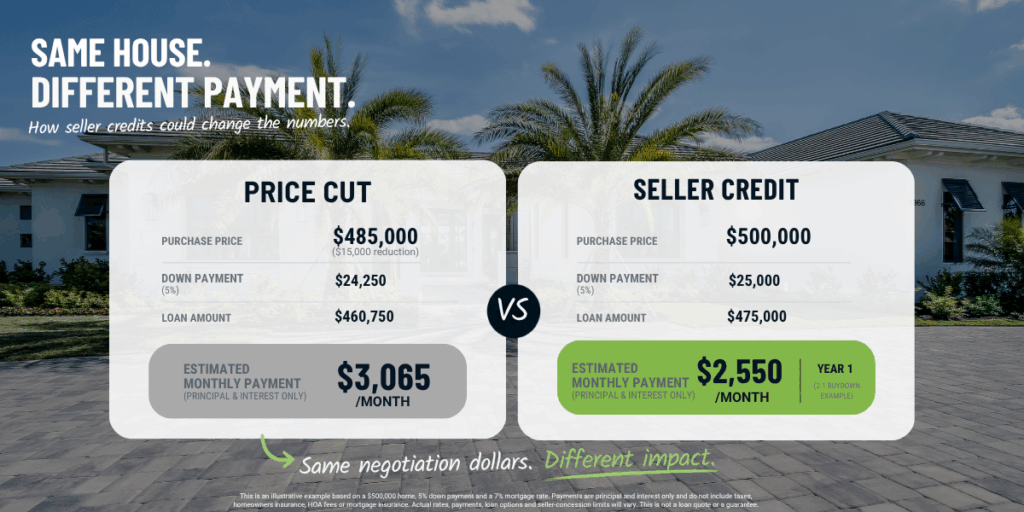
Imagine you’re considering a $500,000 home.
You negotiate hard and convince the seller to reduce the price by $15,000.
Great, right?
Maybe.
What if instead of simply reducing the price, you negotiated a $15,000 seller credit and used some or all of that money strategically to address your monthly payment?
Using an illustrative example of a $500,000 home, 5% down and a 7% mortgage rate, a $15,000 price reduction results in an estimated principal-and-interest payment of approximately $3,065 per month.
In an example using a seller credit, $11,071 could instead be applied toward a 2-1 temporary rate buydown, producing an illustrative first-year principal-and-interest payment of $2,550 per month.
Same pool of seller concession dollars.
Very different short-term impact on the buyer’s monthly budget.
These figures are illustrations rather than quotes or guarantees, but they demonstrate an important concept:
Don’t negotiate only the price. Look at the payment, too.
What Is a Mortgage Rate Buydown?
A mortgage rate buydown is a financing strategy that can reduce the effective interest rate or payment for a period of time—or, depending on the structure, for the life of the loan.
There are two broad approaches buyers may encounter.
Permanent Rate Buydown
With a permanent buydown, funds are used to pay discount points upfront in exchange for a lower mortgage interest rate for the life of the loan.
For someone who expects to keep their mortgage for a long time, that can potentially create meaningful long-term savings.
However, there’s a breakeven point. If you sell or refinance relatively quickly, you may not keep the original loan long enough to realize the full benefit.
That’s why this shouldn’t be an automatic choice.
Temporary Rate Buydown
A temporary buydown works differently.
The mortgage itself retains its note rate, but funds are set aside to subsidize a portion of the buyer’s payments during the first one, two or three years, depending on the structure.
You might hear terms such as:
3-2-1 buydown: Payments are calculated as though the rate were 3 percentage points lower in year one, 2 points lower in year two and 1 point lower in year three before returning to the full note rate.
2-1 buydown: Payments are calculated using a rate 2 points lower during year one and 1 point lower during year two.
1-1 buydown: The payment receives the same temporary reduction for the first two years.
1-0 buydown: The reduction applies during the first year.
A temporary buydown isn’t a workaround for mortgage qualification. Qualification requirements depend on the loan program and lender, so buyers should review the structure with their lender.
Why Seller Credits Matter in the Orlando Housing Market
Here’s the opportunity Orlando buyers shouldn’t overlook.
When sellers have more competition for buyers, buyers can potentially negotiate more than just the sticker price.
That could mean negotiating repairs, closing costs, seller concessions or financing strategies that address affordability.
The Florida data included in the training material behind this example found 72.1% of Orlando homes in its dataset sold below their original asking price, with an average discount of 8% among the Orlando homes that sold below asking.
That doesn’t mean every Orlando seller will accept an offer below asking—or that every buyer should make one.
It means buyers should understand that asking price isn’t necessarily the end of the conversation.
Seller Credit vs. Price Reduction: Which Is Better?
There’s no universal answer.
It depends on what problem you’re trying to solve.
If your priority is getting the purchase price as low as possible, a price reduction may be attractive.
If the monthly payment is keeping you from moving forward, using seller dollars toward an eligible rate buydown could potentially have a greater immediate impact.
If cash-to-close is your biggest hurdle, using available credits toward eligible closing costs could make more sense.
And if mortgage insurance is contributing significantly to the payment, there may be other structures worth discussing with your lender.
For buyers exploring seller credits in Orlando, the important thing is to understand that the best concession isn’t always the one that lowers the purchase price the most. It’s the one that best addresses your actual affordability challenge.
Instead of only asking:
“How much under asking can we offer?”
A better question may be:
“How can we structure this offer to solve the thing that’s actually holding me back?”
Should You Wait for Mortgage Rates to Drop?

This is probably one of the biggest questions Orlando buyers are asking right now.
Nobody can tell you with certainty what mortgage rates will do next.
Waiting for rates to fall also assumes everything else stays the same.
It might not.
If rates fall, more buyers could return to the market. More competition could mean less negotiating power, fewer seller concessions or higher home prices. Or market conditions could move in another direction entirely.
Rather than trying to perfectly time interest rates, consider the factors you can evaluate today:
What homes are available? What can you comfortably afford? How motivated is the seller? What concessions might be available? And how could your offer be structured?
If the numbers don’t work, don’t force them.
But if the right home is available and the payment is what’s stopping you, it’s worth finding out whether there is another way to structure the deal before deciding to wait.
An Orlando Home Buyer Example
Let’s return to that $500,000 example.
The scenario assumes:
Purchase price: $500,000
Down payment: 5%
Loan amount: $475,000
Note rate: 7%
The illustrative principal-and-interest payment is approximately $3,160 per month, excluding items such as taxes, homeowners insurance, HOA fees and mortgage insurance.
With an illustrative 2-1 buydown funded by a seller credit:
Year 1: approximately $2,550/month
Year 2: approximately $2,848/month
Year 3+: approximately $3,160/month
That’s roughly $610 less per month during year one and $312 less per month during year two in this particular example.
Again, these are illustrations—not current mortgage quotes—and your actual rate, payment, loan options and seller-concession limits will vary.
But they demonstrate why buyers shouldn’t look at the list price and mortgage rate in isolation.
Before You Make an Offer on an Orlando Home
This is where having your real estate agent and lender communicating with each other becomes incredibly valuable.
Before writing an offer, determine what you’re actually trying to solve.
Is it the monthly payment? Cash needed at closing? Interest rate? Mortgage insurance? Purchase price?
Once you know the answer, your agent can evaluate the property, its time on market, previous price changes, comparable sales and other factors to determine what negotiating opportunities may exist.
Then your lender can run the actual numbers.
Sometimes the answer will be a lower price. Sometimes it may be Orlando sell</strong>er credits. Sometimes it could be a combination.
And sometimes the numbers simply won’t make sense.
The goal isn’t just to negotiate a deal. It’s to negotiate a deal that works for you.
Thinking About Buying a Home in Orlando?
Don’t automatically assume you have to sit on the sidelines until mortgage rates fall.
Seller credits, rate buydowns and other negotiating strategies may provide more ways to improve affordability than you realize.
The Nickley Group can help you understand what’s happening in the Orlando housing market, identify homes where there may be negotiating opportunities and work alongside your lender to explore the options available for your specific situation.
Ready to see what you could negotiate? Let’s talk.
For your featured image, use the alt text “Seller credits in Orlando vs. home price reduction.” You’ll still need to add one internal TNG link and one authoritative external link to clear those last Yoast warnings.